

Table of Contents
- Why DIY Traps Usually Fall Short
- Step 1: Inspection and Identification
- Step 2: Targeted Treatment
- Step 3: Entry Point Proofing
- Step 4: Monitoring and Follow-Up
- DIY vs Professional Rat Control
- Signs You Need a Professional, Not a Trap
- What to Expect During a Service Call
A scratching sound in the ceiling at 2 am is the first clue most people get. By the time you hear it, the rats have usually been there for weeks. Professional rat removal isn’t a single action like setting a trap; it’s a four-stage process built around finding every access point, not just the one rat you happened to see.
This matters because rats breed fast and adapt to whatever you throw at them once. A trap that worked last month stops working the moment a rat learns to avoid it. Exterminators get around that by treating the whole property, not just the room with the droppings.
This article walks through exactly what a professional does at each stage, why DIY traps typically stall out, and how to tell when it’s time to stop trying it yourself.
Why DIY Traps Usually Fall Short
Store-bought traps and bait work on the rats that find them. They do nothing for the rats that don’t.
Trap placement is one of several common mistakes in DIY pest control, alongside under-treating active nests and skipping entry point sealing entirely.
A rat colony nests in the spots a person can’t easily reach: wall cavities, roof voids, under concrete slabs. Rats will travel up to several house blocks to find water and food, which means the rat caught in your kitchen trap may not be part of the breeding population still active in your roof.
Placement is the other failure point. Rats travel along edges and walls rather than crossing open floor space, so a trap placed in the middle of a room rarely gets touched. Professionals know the travel paths because they look for the physical evidence: grease marks, droppings, and gnaw trails along skirting boards.
Step 1: Inspection and Identification
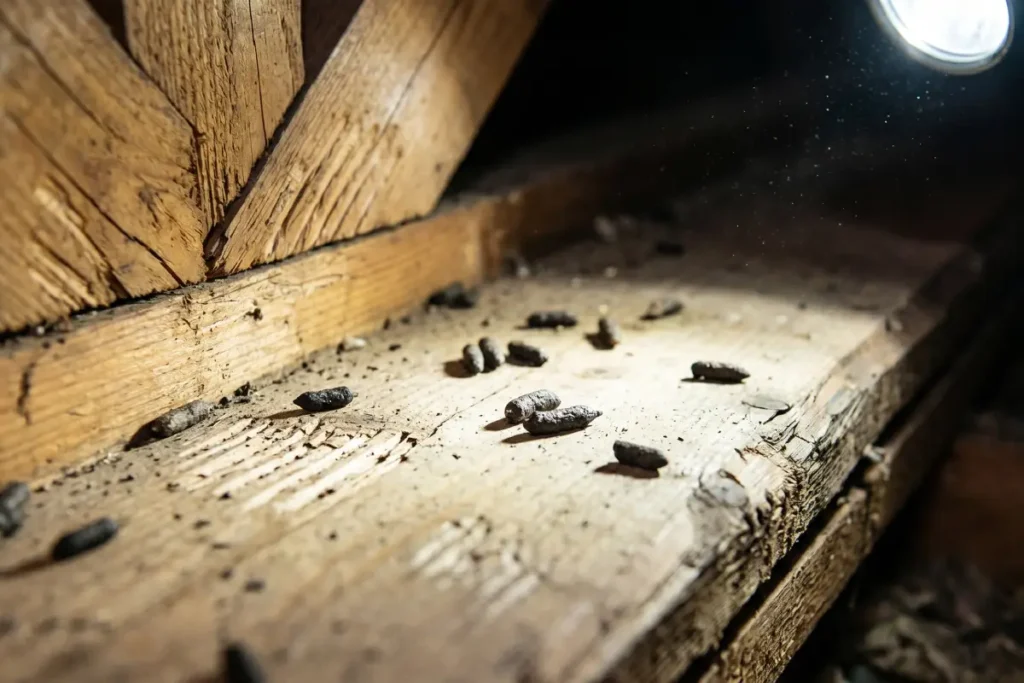
Every legitimate treatment starts with confirming what you actually have, not assuming. Black, moist, thin droppings indicate active presence, while older, dry droppings suggest the infestation may be historic or declining.
Species identification changes the entire treatment plan. Rats are grey, brown or black in colour and larger than mice, reaching up to 25cm in body length and 400g in weight, while house mice are considerably smaller. Roof rats nest high in ceiling voids; Norway rats burrow at ground level. A technician who doesn’t separate these gets the bait placement wrong from the start.
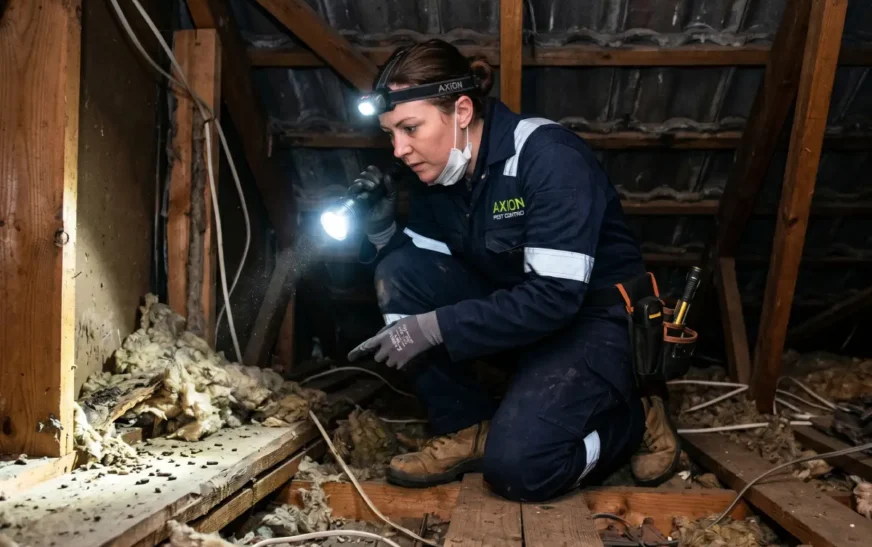
The inspection also maps entry points: roof tile gaps, vent covers, gaps around pipes entering the house. This map becomes the basis for both treatment and the proofing stage later.
Step 2: Targeted Treatment
Treatment uses two tools, chosen based on the inspection: bait stations and mechanical traps. Bait stations are locked, tamper-resistant boxes placed along confirmed travel paths, not scattered randomly. This keeps pets and children away from the bait while still putting it where rats actually walk.
Snap traps and other mechanical traps are used where bait isn’t appropriate, such as roof spaces above living areas, where a poisoned rat could die and decompose somewhere unreachable. If rodents die and decay in hard to reach places they may cause an offensive odour, and a professional plans trap placement specifically to avoid that outcome.
Treatment isn’t a single visit for an active infestation. A property with confirmed breeding activity typically needs a follow-up within one to two weeks, since rats reproduce faster than a single treatment round can clear.
Step 3: Entry Point Proofing
Treating the rats already inside without sealing how they got in just resets the clock. Proofing closes the gaps identified in the inspection: steel mesh over vents, sealant around pipe penetrations, and repaired roof tiles.
This step only works after treatment, not before. Sealing entry points while rats are still active inside traps them indoors, which creates a worse problem than the one you started with.
Materials matter here. Rats gnaw through soft plastics and timber, so proofing uses steel wool, metal mesh, or concrete rather than anything a rat can chew through in a single sitting.
Step 4: Monitoring and Follow-Up
A follow-up visit checks bait stations for activity, removes any dead rodents, and confirms no new entry points have appeared. This is also when a technician checks whether the original treatment actually worked, since reduced droppings don’t always mean zero activity.
Ongoing monitoring matters more for properties near food sources, like restaurants or properties backing onto waterways, where reinfestation risk stays elevated year-round.
DIY vs Professional Rat Control
| Factor | DIY Approach | Professional Approach |
| Identification | Guesswork based on visible droppings | Species confirmed via droppings, gnaw marks, and entry points |
| Treatment placement | Wherever convenient | Mapped to confirmed travel paths |
| Hidden nesting areas | Usually untreated | Inspected via roof void, wall cavity access |
| Entry point sealing | Rarely addressed | Standard final step |
| Follow-up | None | Scheduled re-check |
| Risk to pets/children | Higher with open bait | Lower with locked bait stations |
Signs You Need a Professional, Not a Trap
Daytime sightings are the clearest signal to stop relying on store-bought solutions. If you see rats or mice during the day, this usually indicates high numbers or that there is a good food supply nearby, which means the population has likely outgrown what a few traps can handle.
Other signals include scratching noises that persist for more than a few nights, droppings appearing in new rooms each week, and gnaw damage to wiring. Wiring damage in particular is a fire risk, not just a nuisance, and isn’t something to wait out.
Commercial properties, especially food premises and childcare centres, should treat any sighting as immediate action regardless of severity, since compliance and liability exposure differ from a private home.
What to Expect During a Service Call
A technician arrives, walks the property checking the signs already covered, then explains what they found before treatment starts. A reasonable provider quotes based on property size and infestation severity rather than a flat rate that ignores both.
Same-day treatment is achievable for confirmed infestations once the inspection is done. Some Brisbane-based providers, including Rodent Pest Control Brisbane.com, offer this for residential and commercial properties across the wider Brisbane area.
Expect at least one follow-up visit to be included in the service, not offered as a separate paid add-on. If a quote doesn’t include a follow-up, ask why before booking.

Conclusion
Professional rat removal works in four stages: inspection to confirm species and entry points, targeted treatment placed along actual travel paths, proofing to close the gaps that let rats in, and follow-up monitoring to confirm the treatment held. Each stage depends on the one before it, which is why skipping inspection or proofing is the most common reason DIY attempts fail.
The difference between a trap that works and one that doesn’t usually comes down to whether someone mapped the property first. That’s the part a single store-bought trap can’t do on its own.


